HISTORICAL
BACKGROUND
© “An informative introduction to Atlanta, Georgia” by City Geek
To understand what Atlanta is gentrifying and how it became a target for gentrification, our group believes it is necessary to characterize the city and its history through historical background.
Early Atlanta
Racial Division through Redlining Maps
This map comes from the Mapping Inequality project at the University of Richmond. Mapping Inequality is an online archive that compiles historical “redlining” city maps and their neighborhood data into an interactive map of the United States. ‘Redlining’ refers to the practice conducted by the federal government in the 1930s that created maps for cities all across America which ranked the quality of each neighborhood from :
best
still desirable
definitely declining
hazardous
Click here to visit the Mapping Inequality site to explore the interactive redlining map of Atlanta and read information on the neighborhoods.
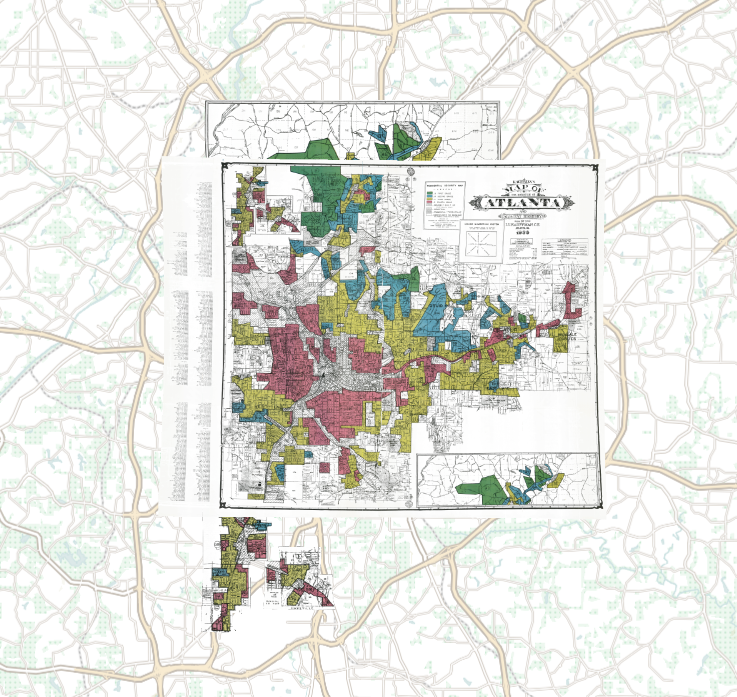
These rankings determined how financially safe it was for banks to give loans or mortgages to residents who lived in these neighborhoods. But how did they decide on the ranking? In short, racial discrimination. Rankings reflected the prevalence of “infiltrating” racial groups in the neighborhood which typically referred to African Americans or other minority residents. So, in other words, neighborhoods that had a strong minority presence were ranked lower while neighborhoods that were predominantly white were ranked higher.
For the minorities living in these ‘hazardous’ or ‘declining’ neighborhoods, their ranking meant that they were unlikely to receive loans or mortgages from the banks, leaving them unable to buy property. This is a significant consequence because one of the most common ways to build intergenerational wealth in America is through property ownership of homes or land. This socio-economic barrier robbed non-white Americans of the ability to buy property, which widened the wealth gap between white and minority Americans resulting in the racial disparities present in today’s society.
Upon inspection of the redlining map of Atlanta, we can see a cluster of red and yellow neighborhoods near the southern half of the city and a grouping of green and blue neighborhoods near the northern half of the city. In terms of the racial demographics of Atlanta, this means that the majority of Black residents lived in the southern part of the city while the majority of white residents lived in the north. This separation underscores the manufactured racial divisions and racism present in 1930s Atlanta that persist to this day.
Atlanta as a Black Mecca
In 1971, Ebony magazine knighted Atlanta with an optimistic nickname — the Black Mecca of the South. The article talks at length about the progress and coexistence the city boasts:
“In downtown Atlanta where black [people] were formerly not welcome or were merely tolerated at a majority of white establishments, brothers and sisters now mingle freely in the crowd and spend money where they wish.”
The article by no means tries to fetishize or fantasize about Atlanta as a beacon of perfect racial harmony; the very next sentence of that caption contends “But black firms are rarely found in the commercial heart of the city” (Garland 1971).
Ebony instead tries to celebrate Atlanta as a signal of hope for “peaceful — and profitable — racial coexistence” (Garland 1971). The city was home to a black vice-major and a plethora of happy black citizens in “good positions on commissions, boards, and agencies” (Garland 1971). Atlanta grade schools showed progress toward proper racial integration in a short period of time with only 65% completely segregated schools in the city. Black commerce and businesspeople saw more success than ever. The title of “Black Mecca” felt justified in 1971 because, 40 years ago, Atlanta was taking strides toward equality and justice that nobody in America expected to see so soon after the Civil Rights Act.
Possibly the greatest takeaway from this article is the idea that Atlanta was, once upon a time, supposed to be a beacon for equality. The equality that Atlanta stood for many years ago is diametrically opposed to the redlining that minority citizens faced decades prior and the gentrification that the city struggles with today. Former hubs of black excellence in politics, commerce, and art that blossomed despite widespread anti-blackness now face relocation, appropriation, and even extinction. The commercial success and affordability that Atlanta enjoyed when that article was released overcame decades of systemic racism and is now up against an influx of wealthy filmmakers trying to take over the pieces of Atlanta that inspired the article in the first place. White suburbs seen expanding and escaping the city center are now flooding back in. Meanwhile, poorer minority citizens are being forced out of formerly affordable urban centers into similarly unaffordable suburban sprawl already defined by excess and inaccessibility.
A Cultural Shift
Atlanta’s regression from a Black Mecca is owed, in some not insignificant part, to the film industry. Starting in the 2000s, the rich history and cultural identity of Atlanta was put into danger by the Georgia government. Georgia had new plans to put Atlanta on the map as a major American city with the introduction of the film industry as a catalyst. Ignorant or perhaps indifferent to the fact that this process could marginalize their historic black community.
The film industry has long been a predominantly white space. We can see this reflected in the very structure of how film is celebrated. As of publishing this, only five black men and one black woman have won the Best Actor/Actress Oscar. The Oscars did not award Best Director to a non-white person until Ang Lee in 2005. It seems obvious in hindsight that Atlanta was introducing an overwhelmingly white industry that would fail to serve the needs of its historically black population; only one could come out unscathed.
But, why has there been a rise of the film industry in Georgia? How did this come about and what does it mean for the city?
Origins of Film Industry in Atlanta
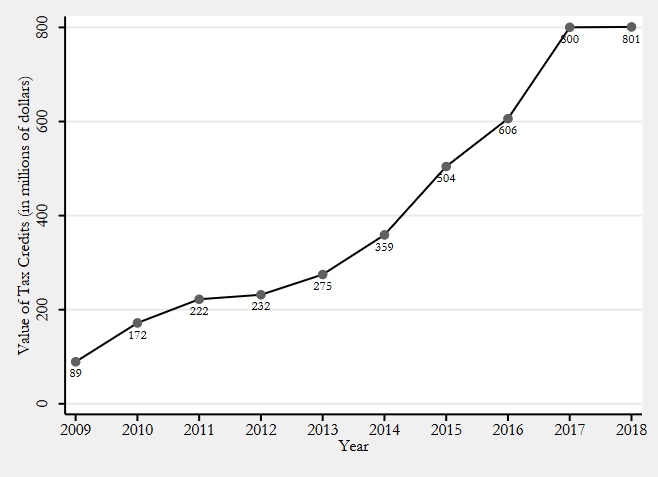
The short answer as to why there has been a rise in the film industry in Georgia is, in a word, tax credits.Starting in 2005 with the Georgia Entertainment and Industry Investment Act, the state began to offer tax credits to film production studios as an incentive for them to film their movies in Georgia. How this works is that Georgia promises to reimburse filmmakers for a percentage of their filming costs in the form of tax write-offs which reduces the amount they need to pay in annual taxes. This theoretically benefits Georgia by encouraging filmmakers to come to cities like Atlanta which, in turn, stimulates the economy and brings in money to the state, but as we will see in “The Economic Effects” section, this might not necessarily be the case.
As of 2019, “Georgia offers the greatest subsidies to filmmakers among US states” and as you can see in the chart, the amount of subsidies that the state awards is only increasing (Bradbury 2019). Specifically, in 2019 Georgia gave out a total of “$860 million” in tax credits to film studios (Bradbury 2020).
The following timeline will outline the details of the creation of the tax credit system in Georgia and the subsequent growth of the Georgian film industry.
As you can see in the timeline, following the introduction of the Georgia Entertainment and Industry Investment Act in 2005, many large, high-budget movie franchises began to make their way to Georgia, and specifically Atlanta. Likely to benefit from the money they could gain from Georgia’s unrivaled tax credit system.
Next, we will investigate the economic effects of this film production migration.
The Economic Effects
One of the main reasons the Georgia government supported the rise of the film industry in Atlanta despite its potentially harmful effects to communities is because they believed that the movie business would boost the state’s economy. They reasoned that the introduction of new money into the Georgian economy can bring about some of the following positive effects:
- Create more jobs
- Raise the income of residents
- Bring revenue to the state
In contrast, several journals have come out in opposition of this point of view and posit that the effects of the film industry on Georgia’s economy are not as positive as the government expected. Notably, Economist John Charles Bradbury refutes each one of the earlier claims in his article, “A Comment on Georgia Department of Economic Development Report: The Economic Impact of the Film Industry in Georgia”.
- In regards to the claim of that the film industry creates more jobs, Bradbury states that before the introduction of tax credits for film studios, “Georgia employed an average of 2,154 [film] workers per year” whereas after the implementation of tax credits, this figure only increased by a small amount to “2,989 film workers per year” which is not a significant increase when considering the increase in amount of movies made (Bradbury 2020).
- Bradbury debunks the common belief that the growth of the film industry corresponds to a growth in the incomes of Georgia film workers by revealing that the median income of these workers is, in fact “well below the current median wage of all US workers” (Bradbury 2020).
- Bradbury points out a loophole which allows filmmakers to sell their awarded tax credits to people who owe tax money to the state, effectively giving Georgia a net zero gain on tax revenue. Rather than bringing revenue to the state of Georgia, Bradbury argues that because of this loophole in the state’s current tax credit system, the presence of the film industry actually “represents an awesome amount of forgone tax revenue…equivalent to…$230 per Georgia household per year” (Bradbury 2020).
Based on these points and more, Bradbury concludes that “the film industry is not a major driver of economic output or jobs in the state” (Bradbury 2020).